Anyone who follows any of my blogs will know that I'm passionate about the topic of narrative influence and control in Homestuck, and that it's to my immense sadness that 'narrative control' has come to be understood as a special power unlocked by only certain characters (perhaps as part of the god tiers, or part and parcel with the Ultimate Self). The fact that anyone can influence and take control over parts of the narrative is a crucial and fascinating part of Homestuck's world, and perhaps one of the best ways to understand this is thru observing the narrative influences of the Epilogues' two opposing forces - Dirk and Calliope - in their native original-comic habitat.
Dirk is no doubt the better understood of the two, because most all readers understand his manipulation of the text in Jane's copy of Detective Pony to prefigure his takeover of events in the Epilogues, even if (within the medium of the text) that happens to be more a figurative example than a literal one. Others still - though this is a more controversial comparison by far - will recognise Dirk's spiritual connection to Doc Scratch, who quite infamously hijacked quite a stretch of the original story with his own egregiously coloured text. But the similarities between Scratch and Strider's modi operandi are actually far more literal than they are abstract!
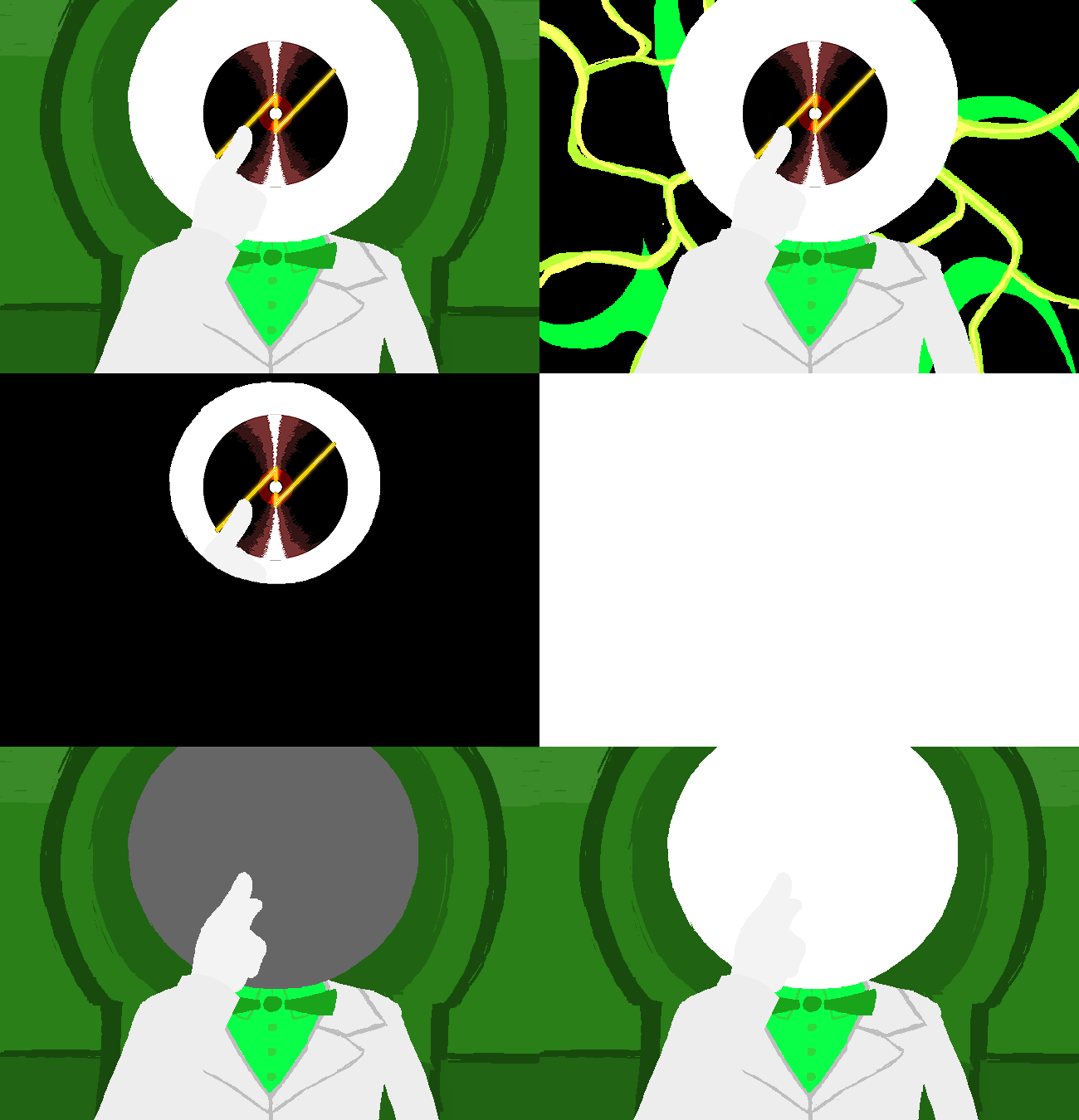
The circumstances that lead to Scratch's takeover of the textual narrative are quite specific: Terezi goofs off like a stupid zoomer and tries to play Homestuck's second disc in a gramophone record player, scratching the delicate surface; with the story's data corrupted, glitches begin to overtake the next 30 pages of the comic, and past ancestral events start to bleed through into the present; and with Terezi's attempt to stop Vriska things finally become so bad that the game becomes totally unplayable, a "s¤ratch dØctor" called in to fix the problem.
Scratch's subsequent actions make it clear what exactly it means to be a "scratch doctor" - it means you're somebody that "doctors" scratches. While the disc is removed, Scratch takes it upon himself to fill in the gaps, so to speak; not just by providing his account of what might happen following Terezi and Vriska's confrontation, but also by filling in the gaps of Alternian history with his "troll fanfiction". He "doctors" the Scratch he and his master forced the Beforans to undertake by rewriting Alternian history with his own narrative.
(as a digression, this is one of a couple awesome examples of events in Homestuck taking place simultaneously in the past (Scratch has been influencing Alternian history since the planet's birth) and in the present (Scratch rewrites Alternian history by getting his hands on the story's second disc): when the reader is first introduced to Jack Noir, he tells us that his "FOURTH WALL was stolen some time ago." But in fact we can identify the exact moment in which Jack loses his fourth wall - it's the very previous two pages, where the author's hands directly meddle with the story by ordering Jack to give his name and rank! Isn't metafiction fun.)
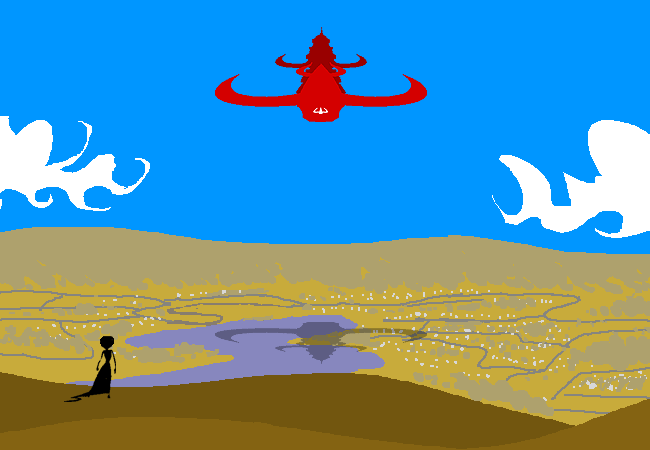
What this has to do with our boy Dirk is that he's guilty of doing the exact same thing. While he may not (necessarily) be responsible for engineering the actual scratch that gave life to his timeline, he takes full advantage of the gap left in its wake: essentially everything we know about the history of the post-scratch Earth comes from walls of orange text (which are even framed as ancestor stories). This may not come across as exactly the kind of nefarious meddling Dirk would go on to engage in, nor do we even necessarily have to concede that this is deliberate on Strider's part; but it is exactly narrative influence as the Alternate Calliope describes it in the Epilogues. The fact that the information comes to us in orange words subtly shifts the nature and the meaning of the message being delivered, and the fact that we as the reader are not compelled to question the origin or potential biases of the message is exactly what makes it so effective at controlling our understanding of the narrative!
Dirk even knowingly uses his status as singular narrator of Earth's history to subtly push his own agendas, such as when he tries to nudge Jake into coming to the conclusion that he and Jane are cousins. (Whether it is to the timeline's ultimate benefit or detriment that Jake is too stupid of an audience to pick up on some of these subtleties, I'll leave you to decide.)
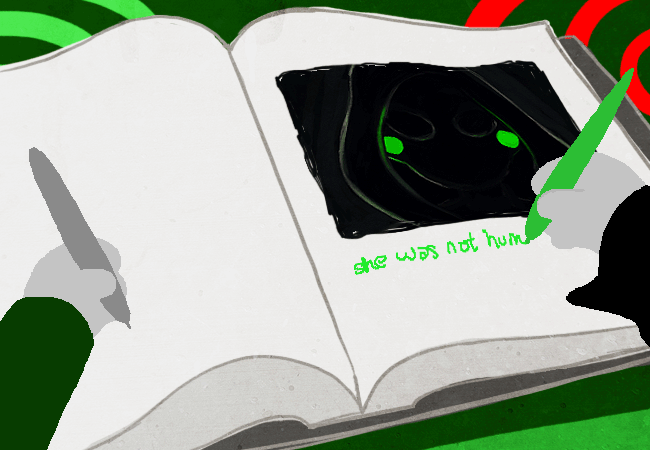
With all that in mind, it should be easier already to see how Calliope's position as an author-figure was seeded from the outset of their introduction as a character - and indeed how it ties into other ongoing debates about Callliope, and about the nature of narrators and their reliability in Homestuck and in fiction more widely. Because when Calliope dumps all that information on us about classpect - about active and passive classes, the gender sways of Bards and Rogues, and the ultimate purpose of a Prince of Heart - they are in effect taking the reins of the classpect "narrative" in both hands. Which is not to say that nothing Calliope says about any of this is to be taken seriously: nor, conversely, is it to say that we should take it all at face value just by virtue of its being "narration". The point of the grey text is the same as that of the white text and the orange text (and of course the black text too) - we understand the story better by questioning and understanding its nuances and implicit agendas, rather than by dismissing it outright because of them.
To this end, when Calliope takes over the similar duty of illustrating Homestuck for a time (above), it should be approached the same way we approach Caliborn's ventures into the same: deliberately or not, to be solely responsible for conveying part of the story is to take the reader (and the characters!) hostage. They do not get a choice in whether or not to 'believe' what they see on the page before them; their only choice, as with the rest of this story or indeed any story, is in how to interpret it. And Calliope can become very defensive of how they want their version of the story to be interpreted! To the point that even the way they present themselves visually to the people around them is a kind of strictly controlled narrative.
Having established all of this it becomes easier still to understand how all sorts of other characters - like Aranea, first introduced as a documentarian of Alternian history in the form of Spinneret Mindfang, and then by the end of the comic trying to shape the direction the story goes in an overtly literal sense - influence the narrative in all kinds of ways, even when they can't see the story's overarching shape in the way that the grander manipulators like Dirk and Alliope can. But with the basic concepts laid out, I'd like to leave some of that discussion to you the beautiful audience... is it BEAUTIFUL AND TRUE that Dirk and Callie have always been some of Homestuck's most nefarious manuscriptnipulators or is this all mere nuance. is it all mere agenda